Living and working abroad can be something you worked toward for years. You may have learned German, built a career, dealt with bureaucracy, found an apartment and created a new life.
And still, at some point, you might find yourself asking: Should I stay in Germany or leave?
For international talents, this question can be surprisingly difficult. Leaving can feel like giving up on something you invested a lot of time, money and energy into building. Staying, however, is not automatically the right decision just because getting here was difficult.
Sometimes the more important question is not whether you can continue living in Germany, but whether you still want to.
Why Leaving Germany Can Feel Like Failure
Moving to another country often comes with a clear goal.
You wanted to study in Germany. Build an international career. Find better professional opportunities. Experience living abroad. Maybe even stay permanently.
Because so much effort goes into reaching that point, changing your mind can feel uncomfortable.
You might think:
“I worked so hard to get here. How can I just leave?”
“Maybe I haven’t tried hard enough yet.”
“What will my family and friends think?”
“Shouldn’t I first find a better job before making such a big decision?”
This is where the sunk cost effect can become important. The more you have already invested into something, the harder it can become to walk away from it — even when continuing is no longer making you happy.
But the years you spent in Germany do not become meaningless because you decide to leave. You still gained professional experience, international exposure, language skills, connections and a much clearer understanding of what you want from your life and career.
Should I Stay in Germany? Start by Separating Career and Life
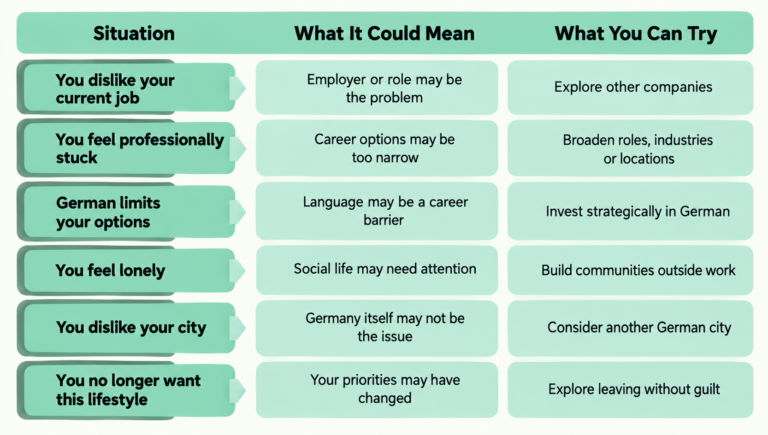
Job satisfaction and satisfaction with your life in Germany are connected, but they are not the same thing.
If you dislike your current job, a new employer might genuinely change your situation.
If your biggest challenge is limited career opportunities because of your German level, improving the language could create significantly more options.
But if you have changed jobs, moved cities or repeatedly tried to build a different life and you still feel unhappy, the problem might not simply be your current position.
Ask yourself:
If I had my ideal job in Germany tomorrow, would I actually want to stay?
This can be a useful question because it removes the job search temporarily from the equation.
If your answer is a clear yes, your priority may be improving your career situation.
If your answer is still no, another job might not solve the bigger problem.
What Is Actually Making You Want to Leave?
Your Job Search in Germany Can Affect How You Feel About the Country
For many international talents, life in Germany becomes closely connected to their job search.
After dozens of applications, rejections or months without finding the right position, it is understandable to start questioning whether Germany is still the right place.
Before making a decision, however, it can help to understand whether you are facing a temporary job-search problem or a broader mismatch.
The German job market can be challenging for international candidates. Depending on the role and industry, German language skills may significantly increase the number of available positions. English-speaking jobs exist, but they often attract a large international candidate pool.
Your international background can also be an advantage for some employers, especially in international teams and companies. But it does not automatically compensate for every requirement listed in a job advertisement.
If your frustration mainly comes from your current job search, improving your strategy may therefore be worth trying before making a larger decision.
Before Leaving Germany, Check Whether Your Job Search Needs to Change
Applying to more jobs is not always the solution.
If you have already submitted many applications without getting interviews, look at where the process is breaking down.
Are you targeting positions where your experience actually matches the requirements?
Does your CV make your relevant skills easy to understand?
Are you focusing almost exclusively on highly competitive English-speaking roles?
Are you applying only in one city?
Are you considering companies where international candidates realistically have opportunities?
Sometimes a relatively small change in targeting can improve your results more than sending another 50 applications.
For example, someone searching only for “Marketing Manager” roles in Berlin might discover more opportunities by also considering titles such as Growth Marketing Manager, Content Marketing Manager, CRM Manager or Marketing Specialist.
The goal is not to apply randomly. It is to understand where your experience has the strongest market fit.
Do Not Keep Waiting for the Next Job to Fix Everything
There is another possibility international professionals should consider.
Maybe you have already changed jobs.
Maybe you have moved from one German city to another.
Maybe you have joined international communities, taken German classes or tried new hobbies.
And you still keep thinking about leaving.
At that point, constantly creating another condition before allowing yourself to make a decision can keep you stuck.
“I’ll decide after my next promotion.”
“I’ll give it another six months.”
“Maybe once my German reaches C1 things will feel different.”
There is nothing wrong with setting yourself a realistic timeframe. But if the deadline keeps moving every time it arrives, ask yourself what you are actually waiting for.
You Do Not Need a Dramatic Reason to Leave Germany
One of the hardest parts of moving away can be explaining the decision to other people.
Germany may offer you a stable job, good career prospects or a comfortable life. From the outside, leaving might seem irrational.
But career decisions are not based purely on salary, job titles or economic opportunities.
Relationships matter.
Family matters.
Belonging matters.
Lifestyle matters.
Weather, culture, language and where you imagine your future matter too.
You do not need to prove that Germany is objectively a bad place to live in order to decide that it is no longer the right place for you.
And someone else loving their life in Germany does not mean that you have to feel the same way.
Be Careful With the “One More Year” Trap
Giving yourself more time can be sensible, especially after recently moving to Germany.
Building friendships, understanding workplace culture and feeling comfortable communicating in another language rarely happen immediately.
But “one more year” can also become an automatic response.
If you have been considering leaving for a long time, make the extra year intentional.
Decide what you want to test.
For example, perhaps you want to:
change employers,
reach a certain German level,
try living in another city,
build a stronger social network,
or pursue a different career direction.
Then review the situation again at a specific point.
Do not simply wait and hope that something changes by itself.
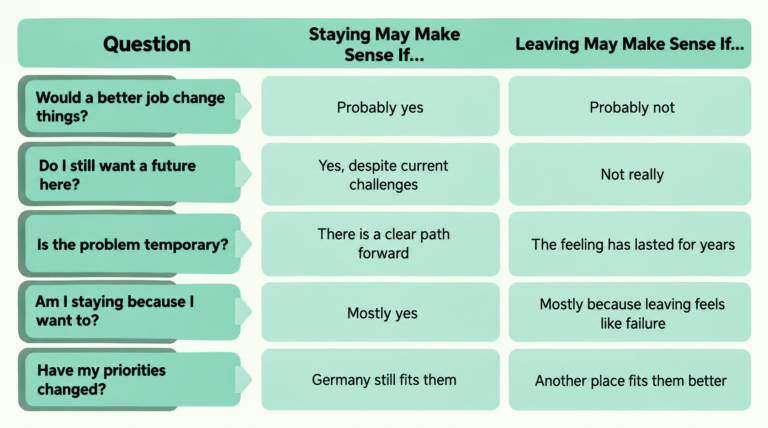
Staying vs. Leaving: Questions to Ask Yourself
What If You Want to Stay but Your Career Is the Problem?
If you still genuinely want to live in Germany, that is valuable information.
Now you can focus on the part that can potentially be changed: your career situation.
Start by becoming more specific.
Instead of thinking, “There are no jobs for internationals in Germany,” look at your actual target market.
Which job titles match your experience?
Which industries regularly hire international professionals?
Which companies operate primarily in English?
How important is German in your specific field?
Could another city give you better opportunities?
You can then build a more targeted job search instead of treating the entire German job market as one category.
What If You Want to Leave but You Are Afraid of Regretting It?
There is rarely a way to know with complete certainty that a major life decision is correct.
You might leave Germany and miss parts of your life here.
You might stay and continue wondering what would have happened if you had left.
Instead of looking for certainty, look at your options.
Research the job market in the country you are considering. Speak with people working there. Check what your qualifications are worth. Think about salary, career opportunities, cost of living and your personal support network.
You do not necessarily need to resign tomorrow.
You can start exploring.
Updating your CV, speaking with recruiters or applying for a few positions abroad can give you real information before you make a final decision.
Your International Experience Is Not Wasted If You Leave
This is especially important if leaving Germany feels like going backwards.
It isn’t.
Working abroad teaches you things that are difficult to learn from a course or degree alone.
You may have learned how to communicate across cultures, navigate unfamiliar systems, work in international teams and adapt when things do not go according to plan.
Depending on your profession, German market knowledge or experience with German companies may also become valuable when applying to international employers elsewhere.
You are not returning to the same starting point you had before moving to Germany.
You are making your next decision with more experience.
Staying in Germany Should Also Be an Active Decision
There is nothing wrong with deciding to stay.
But ideally, staying should be something you choose rather than something that simply happens because leaving feels too difficult.
If Germany still offers the career, lifestyle or future you want, identify what currently needs to change.
Maybe that means finding a new employer.
Maybe it means learning German.
Maybe it means moving from Munich to Berlin, Hamburg to Frankfurt or a smaller city to a larger international hub.
Maybe your job is actually fine and your priority needs to be building a life outside work.
Once you understand the problem, you can work on the right solution.
Final Advice: You Are Allowed to Reconsider the Plan
Moving to Germany does not mean you signed a lifetime contract with the decision.
Your priorities can change.
The career you wanted at 25 might not be the career you want at 32. The city that felt exciting when you first arrived might no longer fit the lifestyle you want. Being far away from family may become more important than it once was.
So if you are wondering, “Should I stay in Germany?”, do not only ask whether staying is still possible.
Ask whether it still makes sense for the person you are today.
If the answer is yes, identify what needs to improve and make a concrete plan.
If the answer is no, exploring your next chapter does not erase everything you achieved in Germany.
Still Unsure Whether You Should Stay in Germany?
Check out our other blog posts for more practical insights on working, living and building your career in Germany. They can help you explore your options and make a decision that feels right for you.
Read more on the CareerBee blog