You finally get the interview invitation. The recruiter sounds interested, the company looks promising, and after sending many applications, it feels good to move forward.
But then things start feeling strange.
The recruiter cannot clearly explain the role. The interview keeps getting rescheduled. Different people tell you completely different things about the position. Or you are asked to prepare a large unpaid assignment before anyone has even properly discussed the job with you.
Recognizing recruiter red flags can be especially difficult when you are an international job seeker in Germany. You may already be unsure what is normal in the German hiring process, which questions recruiters usually ask, or how direct you are expected to be.
Not every disorganized interview means that a company is a bad employer. People make mistakes, schedules change, and hiring processes are not always perfect. But when several warning signs appear together, it is worth paying attention.
The recruitment process is often your first real look inside a company. How candidates are treated can tell you something about communication, decision-making and priorities within the organization.
Why International Job Seekers Should Pay Attention to Recruiter Red Flags
When you are new to the German job market, it can be tempting to accept almost everything as a cultural difference.
You might think:
“Maybe hiring processes in Germany are just like this.”
“Perhaps I should not ask too many questions.”
“Maybe discussing salary this early is inappropriate.”
“Should I just complete the assignment because I really want the job?”
Sometimes cultural differences do play a role. German recruitment processes can be more structured or formal than what you are used to, and some companies take longer to make decisions.
But professionalism should still be there.
A recruiter should normally be able to explain the basic role, communicate important next steps and treat your time respectfully. You should also be able to ask reasonable questions without feeling that you are causing problems.
Understanding this difference helps you avoid accepting poor treatment simply because you are unfamiliar with the local job market.
Recruiter Red Flags Before the First Interview
Some warning signs appear before you even speak to the hiring manager.
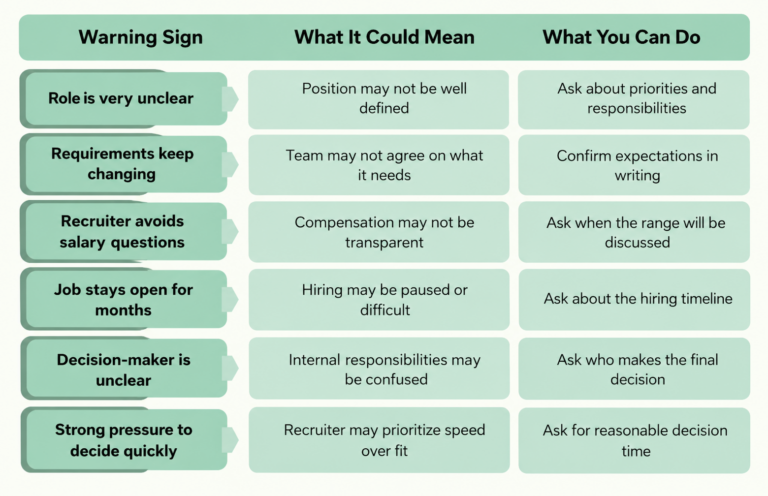
One common example is a recruiter who cannot give you a clear explanation of the role.
You do not need every small detail during the first conversation, but you should understand what the position is supposed to achieve, which team you would join and what the main responsibilities are.
If even the recruiter seems unsure, ask additional questions.
For example:
“What would be the main priorities for this person during the first six months?”
“How is the team currently structured?”
“Who would this position report to?”
“Is this a new position or a replacement?”
Clear answers do not guarantee that the company is perfect. But extremely vague answers can indicate that the role itself has not been properly defined.
Another warning sign is when the requirements suddenly change.
Maybe you applied for a marketing position and later discover that the company actually expects strong sales experience. Or a role presented as junior suddenly requires responsibility for an entire department.
Small adjustments during hiring are normal. A completely different job appearing halfway through the process is not.
Early Recruiter Red Flags
Salary Discussions Can Reveal a Lot
Salary conversations are uncomfortable for many international candidates.
You may already be unsure about German salary levels and worried that asking too much could eliminate you from the process.
A recruiter asking about your salary expectations is not automatically a red flag. This is still common in many hiring processes.
The bigger question is how the conversation is handled.
If the recruiter repeatedly expects you to give a number while refusing to provide any information about the company’s budget, you should become more cautious.
Try asking:
“Could you share the salary range budgeted for this position so we can make sure our expectations are aligned?”
You may not always receive an exact number immediately. But the recruiter should ideally be able to explain when compensation will be discussed and whether your expectations are realistic.
Be particularly careful when the salary, benefits or seniority level suddenly become significantly worse than what was originally presented.
You are interviewing the company too.
When the Interview Process Becomes Chaotic
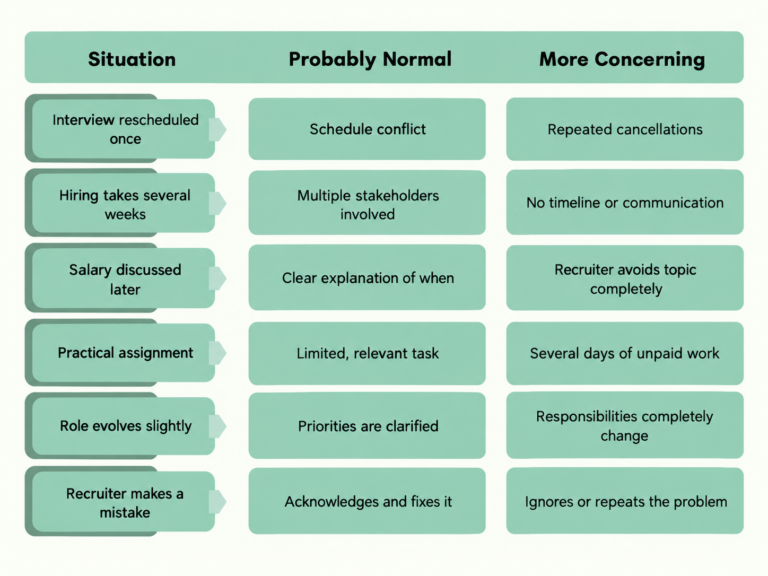
Hiring can take time, particularly in larger German companies where several departments may be involved.
Three or four conversations are not automatically excessive if each meeting has a clear purpose.
The problem begins when nobody seems able to explain why another interview is necessary.
First you speak to HR.
Then the hiring manager.
Then another manager.
Then a future colleague.
Then someone from another department appears unexpectedly.
And after all of that, nobody can tell you what happens next.
A professional hiring process should have some structure, even if the timeline changes.
You can ask early:
“How many interview stages should I expect?”
“Who will I meet during the process?”
“What is your expected timeline for making a decision?”
These questions are completely reasonable.
Constant Rescheduling Is More Than Just Annoying
One rescheduled interview is normal.
People get sick. Meetings run over. Business priorities change.
But constantly cancelling or moving interviews with little explanation shows something different, especially if the company expects complete flexibility from you.
International job seekers may sometimes tolerate this because they do not want to appear difficult.
But your time also matters.
If someone cancels repeatedly, arrives significantly late without acknowledging it or forgets scheduled meetings, you can consider how that behavior might translate into everyday work.
The important question is not whether something goes wrong.
It is how the company handles it.
A quick apology and transparent explanation can make a big difference.
Conflicting Information From Different Interviewers
Imagine the recruiter tells you the role is mostly strategic.
The hiring manager says it is highly operational.
One interviewer tells you the team has ten people.
Another says four.
Someone tells you English is the working language, while another interviewer suddenly says German will be required every day.
These contradictions deserve clarification.
International applicants should pay particular attention to language requirements.
An English-language job advertisement does not always mean that the entire working environment operates in English. Some roles may involve German-speaking customers, internal stakeholders or documentation even when the job advertisement itself is written in English.
Ask directly:
“What language does the team use internally?”
“How much German would I realistically need in everyday work?”
“Would I need German when communicating with clients or other departments?”
If different people provide very different answers, you need to understand which answer actually reflects the role.
When Recruiters Create Artificial Pressure
A company being interested in moving quickly can be positive.
Artificial urgency is different.
Statements such as “You need to decide today” or “We have another candidate waiting, so we need an immediate answer” should make you think carefully, especially when you have not received enough information about the position.
This can also happen with external recruiters.
A headhunter may be financially rewarded when a candidate accepts a position. That does not make external recruiters untrustworthy, but their incentives are not always identical to yours.
You should therefore still do your own research.
Do not allow someone else’s urgency to stop you from asking important questions about salary, responsibilities, team structure, working conditions or company culture.
Be Careful When Recruiters Avoid Difficult Questions
A strong interview is not only about convincing the employer that you are a good candidate.
You should also understand what you are joining.
Ask questions about challenges.
For example:
“What is currently the biggest challenge facing this team?”
“Why is this position open?”
“What made previous people successful or unsuccessful in this role?”
“What would you like the new employee to improve?”
A recruiter does not need to criticize their own company. But if every difficult question is avoided or answered with empty phrases, you may not be receiving the information you need to make a good decision.
Statements like “Our culture is amazing” are less useful than concrete examples of how teams collaborate, how decisions are made or how employees receive feedback.
When Take-Home Assignments Become Excessive
Practical tasks are common for certain roles in Germany, especially in fields such as marketing, design, consulting, data, product or software development.
A short assignment can help both sides understand whether the role is a good fit.
The problem is the amount of work involved.
An assignment that takes one or two hours is very different from being asked to develop an entire strategy, campaign, analysis or product concept that could realistically be used by the company.
Before starting a large task, ask:
“How much time do you expect candidates to spend on this assignment?”
“What exactly are you evaluating?”
“Will the work only be used for recruitment purposes?”
If a company expects a very significant amount of unpaid work, decide whether continuing the process is worth your time.
Messy Process or Serious Red Flag?
Questions That Cross Professional Boundaries
Some questions during an interview may also feel inappropriate.
Recruiters will naturally ask about your professional experience, career decisions and qualifications. They may also want clarification about periods in your CV.
But you should notice when the questioning becomes unnecessarily intrusive.
For example, asking why there is a six-month gap in your CV is different from aggressively interrogating you about personal circumstances.
Similarly, requesting your current manager’s contact information extremely early in the process may create unnecessary risk if your employer does not know you are searching for a new job.
You can respond professionally without immediately agreeing.
For example:
“I would prefer to provide references at a later stage once we know that there is a strong mutual fit.”
A reasonable recruiter should normally understand this.
Poor Communication After the Interview
You finish an interview and hear:
“We will get back to you by Friday.”
Friday passes.
Then another week.
Then another.
Unfortunately, slow feedback or ghosting can happen during job searches.
One delayed response alone does not automatically mean that a company is problematic. Hiring decisions can be delayed for many reasons.
What matters is whether this becomes part of a wider pattern.
If the company repeatedly misses its own deadlines without communicating, consider that when evaluating the opportunity.
A simple message such as “The process is taking longer than expected, and we will update you next week” requires very little effort.
Good candidate communication does not require a perfect process. It requires basic respect.
Should You Walk Away From a Bad Recruitment Process?
Not necessarily after the first problem.
One late interviewer or one confusing email should not automatically determine your opinion of an entire company.
Instead, look for patterns.
Are several people disorganized?
Do the answers repeatedly contradict each other?
Are commitments constantly broken?
Do you feel pressured to accept conditions before receiving enough information?
Are reasonable questions treated negatively?
The more red flags you notice, the more seriously you should consider whether this is the right opportunity.
This can be difficult when you have been job searching for months.
You may think:
“What if this is my only chance?”
That feeling can make it tempting to ignore problems.
But accepting a job that turns out to be completely different from what you expected can create an even bigger challenge later.
How International Candidates Can Protect Themselves
One of the best ways to identify recruiter red flags is to prepare your own questions before every interview.
Do not only prepare answers.
Research the company and think about what you need to know before accepting a position.
Depending on the role, this could include questions about:
- team structure
- working language
- salary range
- remote or hybrid expectations
- responsibilities
- probation period
- interview stages
- management style
- learning opportunities
- reasons why the position is open
You do not need to ask everything during your first interview.
But by the end of the process, you should have enough information to understand what you are actually agreeing to.
It can also help to write down important promises or details after each interview.
If one person says the role is remote and another later says employees must be in the office four days per week, you will notice the contradiction quickly.
What a Good Recruitment Process Usually Feels Like
A good hiring process does not need to be perfect.
It usually feels reasonably clear.
You understand what the job is.
You know why different interviews are happening.
You receive honest answers to most of your questions.
People respect your time.
When something changes, someone explains why.
And you gradually get enough information to decide whether the company is right for you.
That is especially important for international professionals who may be making major decisions around relocation, language learning or building a long-term career in Germany.
The recruitment process should help you understand the opportunity, not leave you more confused after every conversation.
Final Advice: Pay Attention to Patterns, Not Perfection
Recruiter red flags are not about expecting every hiring process to run perfectly.
They are about noticing patterns.
A recruiter forgetting one detail is human. A company repeatedly changing the job, avoiding basic questions, ignoring candidates and creating unnecessary pressure is something different.
During your job search in Germany, remember that an interview is a two-way conversation.
The company is evaluating you.
But you are also evaluating them.
Ask questions, pay attention to how people communicate and do not ignore concerns simply because you really want the position.
The goal is not just to get an offer.
It is to find a job you actually want to accept.
Prepare for German Job Interviews With More Confidence
Understanding recruiter red flags is one part of preparing for an interview. Knowing what German employers may ask, how to structure your answers and which questions you should ask them can make the process much easier.
Our CareerBee Interview Guide for Germany helps international talents prepare specifically for job interviews in Germany, with practical guidance you can use before your next interview.