Are you an international professional looking to work in Germany?
The German job market is competitive, structured, and very different from many other countries. But with the right strategy, international applicants can significantly increase their chances of landing a job in Germany, even from abroad.
In this guide, we share five proven, practical tips that will help you navigate the German job market, avoid common mistakes, and stand out as an international candidate.
1. Localize Your CV to the German Standard (German CV Format)
One of the biggest reasons international applications fail in Germany is an unsuitable CV format. German recruiters expect a very specific structure, and using a U.S.-style resume or generic Europass CV can immediately hurt your chances.
By adapting your CV to the German standard, you show that you understand the local market and are serious about working in Germany.
💡 Key features of a German CV:
Format: Clean, professional layout (often two-column)
Length: Maximum two pages (unless you have 15+ years of experience)
Order: Reverse chronological order
Photo: Common but no longer mandatory
Focus: Work experience is more important than education
Skills: Separate sections for
Technical / Job-related skills
Interpersonal skills
Language skills (very important in Germany)
Bullet points: 5–8 concise, results-focused bullets per role
Gaps: Never hide them. Briefly explain what you were doing (e.g. upskilling, travel, caregiving). Transparency is highly valued.
👉 A localized CV is not optional. It’s a prerequisite for jobs in Germany
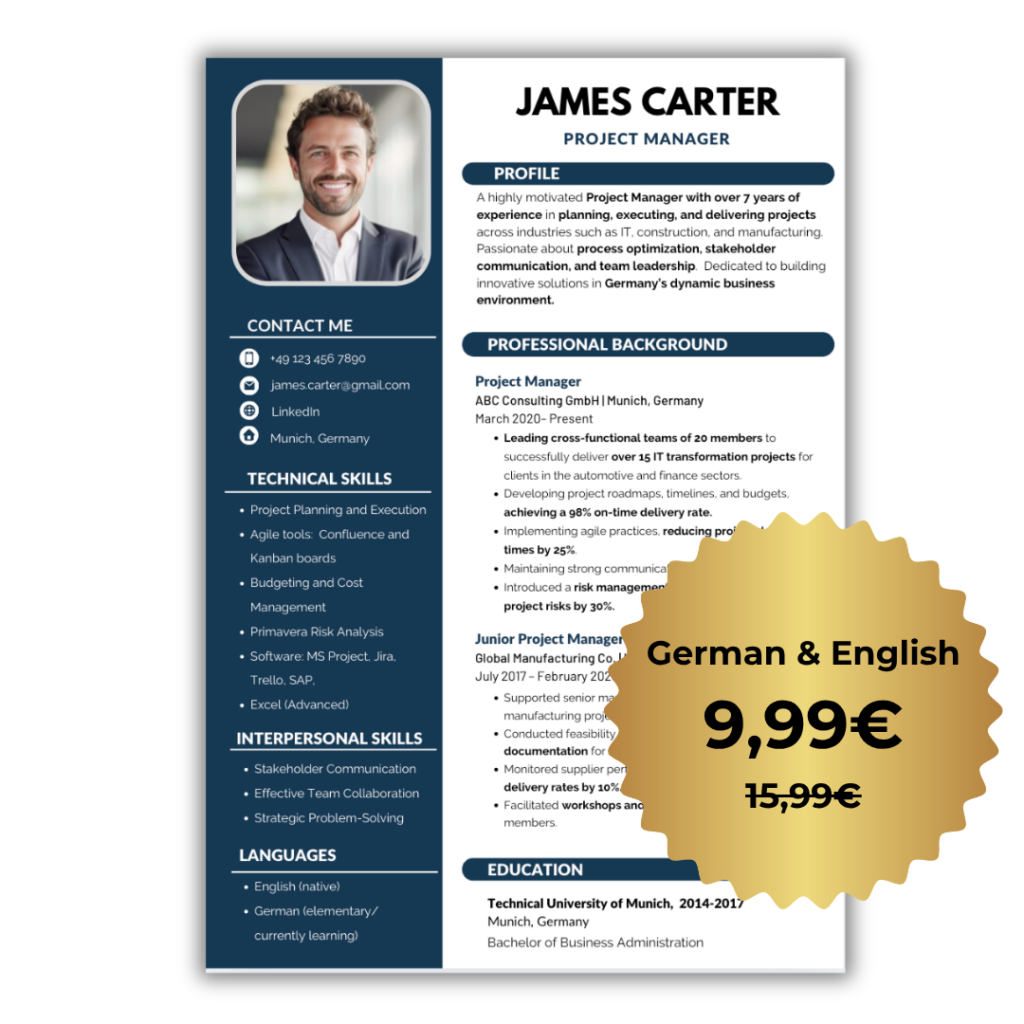
If you’re looking for a CV template that’s already adapted to German hiring standards, you can access it here.
2. Always Apply Directly via the Company’s Career Page
Platforms like LinkedIn, StepStone, and Indeed are excellent for finding jobs, but you should almost always apply directly via the company’s career page.
Why? Because recruiters prioritize applications that come through their own Applicant Tracking System (ATS).
💡 Your advantages when applying directly:
Higher visibility: Recruiters review ATS applications first
Stronger motivation signal: Visiting the career page shows genuine interest
Better personalization: You can upload tailored documents and answer screening questions properly
Less competition: “Easy Apply” often attracts hundreds of generic profiles
✅ A simple rule:
Use job portals to find jobs but use career pages to apply for them.
3. Apply Within the First 72 Hours
As an international applicant, timing matters even more.
Because relocation and visa processes take time, you need to compensate by being early and proactive.
Recruiters are most open during the first few days after a job is posted. Later on, when strong candidates are already in the pipeline, standards become stricter and rejection rates increase.
Action plan:
Set up job alerts on LinkedIn, Indeed, and StepStone
Regularly check the career pages of your target companies
Aim to apply within the first 72 hours whenever possible
💡 Early applications often receive more attention, even if you don’t meet 100% of the requirements.
4. Use the Right Job Portals in Germany Strategically
Relying on just one platform limits your visibility. A smart job search in Germany combines large job portals with niche platforms.
💡 Important job portals in Germany:
Indeed: One of the most powerful tools, as it crawls company career pages automatically
StepStone: One of Germany’s oldest and most established job boards, with strong filters (including English-speaking roles)
LinkedIn: Essential for both job searching and being found by recruiters
Niche job portals: Industry-specific or English-speaking job boards can save time and reduce competition
Quality over quantity
Submitting 50 generic applications is far less effective than sending 10 tailored, fast, and well-prepared applications.
Divide your efforts into:
Plan A jobs: High priority, fully customized applications
Plan B jobs: Less customization, but still relevant
This approach is much more effective for international candidates.
5. Network Strategically — Even from Abroad
Networking is one of the most powerful tools for finding jobs in Germany, especially for international professionals. And yes, it works even if you’re not in the country yet.
💡 How to network effectively on LinkedIn:
Follow companies you apply to and engage with their posts
Connect with employees in similar roles or with people who relocated to Germany
Connect with recruiters, especially in larger companies
Optimize your LinkedIn profile with relevant keywords, skills, and language levels so recruiters can find you
Networking is not about asking for a job immediately. It’s about visibility, credibility, and long-term positioning.
The Long Game: Be Patient and Strategic
Finding a job in Germany typically takes 3 – 6 months, even for candidates already in the country. From abroad, it can take longer and that’s normal.
Many international professionals do succeed in the German job market every year. The difference is not talent, but strategy, preparation, and persistence.
Stay patient, apply smartly, and focus on quality over speed.
Final Thoughts: How to get a job in Germany as an international
Applying for jobs in Germany as an international applicant is challenging, but absolutely possible.
By understanding the local expectations, adapting your CV, applying early, using the right job portals, and networking consistently, you dramatically increase your chances of success.
Germany needs international talent. The key is knowing how to position yourself.
If you are looking for professional support, make sure to check out our CareerBee Career Services. Happy to support you in your job search in Germany.