If you’re applying for jobs in Germany, understanding the German CV is absolutely critical.
Many international candidates have strong experience, solid qualifications, and relevant skills yet they still get rejected. Not because they’re not good enough, but because their CV doesn’t match how recruiters in Germany actually work.
- So how do German recruiters really read CVs?
- How much time do they spend on them?
- And what makes the difference between rejection and an interview invite?
In this article, I’ll take you behind the scenes and explain how recruiters in Germany scan and evaluate a German CV, what they look for first, and how you should adapt your CV to stand out in a highly competitive job market.
The Reality of the German Job Market
Germany urgently needs international talent. Demographic change, an aging workforce, and the retirement of the baby boomer generation have created significant talent gaps across many industries.
At the same time, the job market remains extremely competitive, especially for English-speaking roles.
Why?
Many companies still hire primarily German-speaking candidates
The number of English-only roles is limited
International candidates from all over the world apply to the same positions
💡The result: fewer English-speaking jobs, more applicants, and tougher competition.
That’s exactly why having a well-structured German CV is not optional — it’s essential.
How Recruiters in Germany Actually Scan a German CV
One of the biggest misconceptions candidates have is how much time recruiters spend on a CV.
The reality is very different.
Recruiters in Germany:
Handle very high application volumes
Work on multiple roles at the same time
Recruit across different fields (IT, sales, marketing, finance, operations)
Because of this, CVs are not read — they are scanned.
⏱️ Average scan time: 20–30 seconds
During this scan, recruiters compare your German CV with the job description and ask one simple question:
Can I find around 60–70% of the relevant keywords from the job ad in this CV?
If yes → your CV gets read properly
If no → your application is usually rejected
This insight alone should completely change how you approach your German CV.
Why Keywords and Scanability Matter in a German CV
Because recruiters scan instead of read, your German CV must be:
Keyword-rich
Easy to scan
Clearly structured
This is also why:
3+ page CVs usually don’t work
Overloaded designs reduce readability
Key information must be visible immediately
Rule of thumb for German CV length
0–10 years of experience: 1–2 pages
10–15+ years / senior management: longer CVs can be acceptable
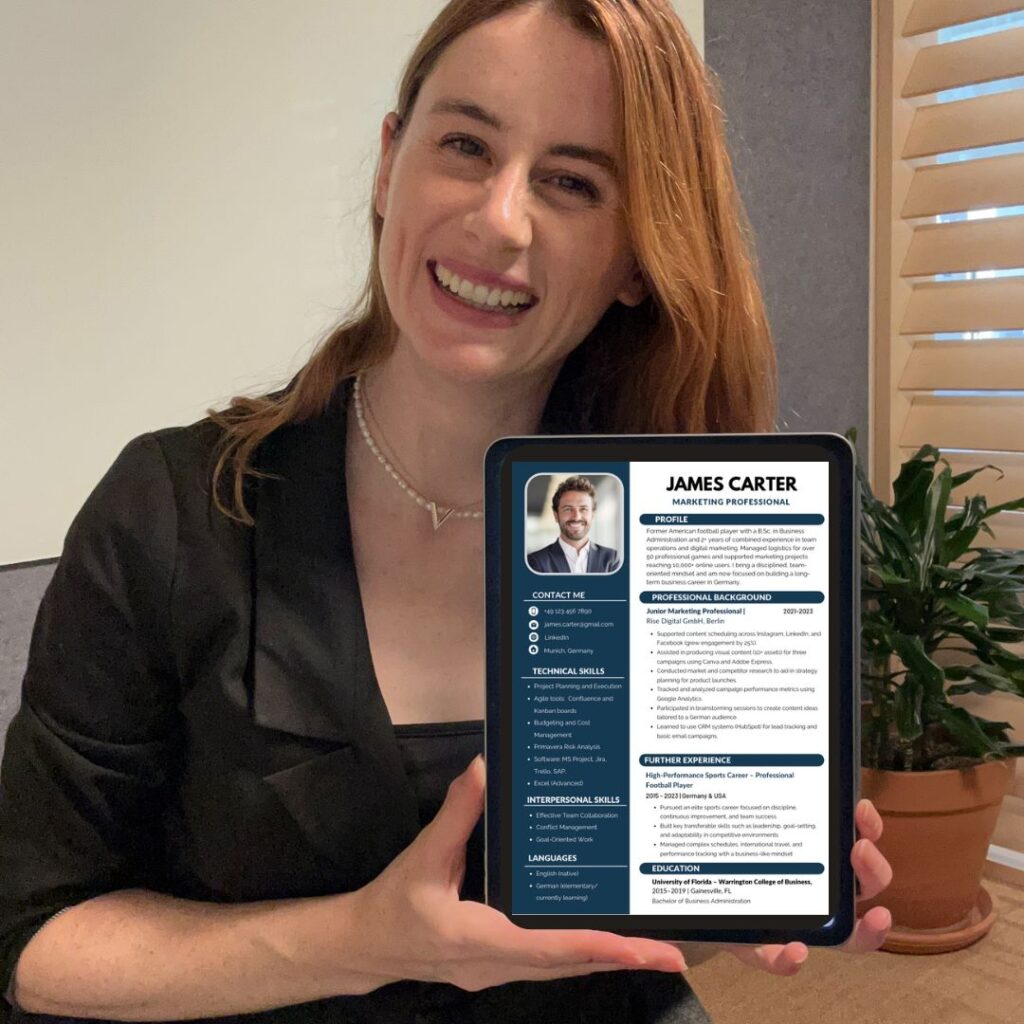
Why a Two-Column German CV Works So Well
A two-column German CV can be extremely effective when done correctly.
Why recruiters like it:
Skills and keywords are visible immediately
Relevant information is easy to find
Page one already shows fit for the role
A German CV is not a life story.
It’s a working tool for recruiters.
If your CV helps recruiters do their job faster, you dramatically increase your chances.
One Critical Rule for a German CV: Use Exact Keywords
Recruiters are not experts in every role they recruit for. Very often, they rely heavily on exact wording from the job ad.
That means:
Synonyms can be risky
Junior recruiters may not recognize equivalents
Exact job-ad language increases your chances significantly
Always assume your German CV is first reviewed by a junior recruiter.
✅ If it’s a senior recruiter – great. But never rely on that.
“Less Is More”: A Core Principle of the German CV
German recruiters value:
Clarity
Efficiency
Relevance
Every line in your German CV should answer one question:
✅ Does this help the recruiter understand why I’m a fit for this role?
If not, remove it.
You don’t need to:
List every certificate you’ve ever earned
Explain every task in detail
Add information just to fill space
In Germany, precision beats completeness.
The Standard German CV Structure Recruiters Expect
For most professionals, the recommended German CV order is:
Work Experience (most important)
Skills (technical + role-relevant)
Languages (with clear levels)
Education
Certificates (only if relevant)
If you have experience that isn’t fully relevant, create a section like:
Further Work Experience
List only:
Job title
Company
Dates
Location
This keeps your German CV clean and focused.
Writing Strong Bullet Points in a German CV
German recruiters love results and numbers.
Instead of:
Responsible for project coordination
Write:
Coordinated a cross-functional team of 6, delivering the project on time and reducing costs by 12%
You don’t need numbers in every bullet point, but where possible, they significantly strengthen your German CV.
ATS in Germany: A Common Misunderstanding
Many candidates believe:
“If my CV isn’t ATS-optimized, it will be rejected automatically.”
In Germany, this is mostly not true.
ATS systems are primarily used to:
Manage applications
Move candidates through stages
Share profiles internally
Send emails
Final decisions are still made by humans.
Automatic rejections usually happen only when:
Knock-out questions are used (visa status, language level, years of experience)
Answers don’t meet predefined criteria
📌 Key takeaway:
You are writing your German CV for a human, not a machine.
How to Lightly Optimize Your German CV for ATS
You don’t need to overthink ATS. Follow basic hygiene rules:
Use standard fonts (Arial, Calibri, Times New Roman)
Avoid heavy graphics and icons
Use clear, standard section titles
Keep formatting simple and consistent
That’s enough.
Final Thoughts: Think Like a Recruiter
A strong German CV is not about perfection.
It’s about relevance, clarity, and scanability.
When you understand how recruiters in Germany work, and adapt your CV accordingly, your chances of getting interviews increase dramatically.
And if you want hands-on support with real German CV examples, templates, common mistakes, live Q&A, and guidance on how to use AI correctly as a candidate, we’d love to support you at CareerBee.
Want to turn your CV into a recruiter-ready German CV?
In our CV Event 2026, we show you exactly how recruiters in Germany scan CVs, which keywords really matter, and how to structure your German CV so it passes the 20-second scan and stands out to hiring managers.
👉 Join the CV Event 2026 here