Every November, many employees in Germany notice a noticeably higher payslip. The reason is the Christmas bonus, known in German as Weihnachtsgeld, or a 13th monthly salary. If you are new to Germany, the Christmas bonus in Germany can be confusing: Is it guaranteed? How much is normal? And do you have to pay it back if you change jobs?
This article explains the difference between Weihnachtsgeld and a 13th salary, how both are taxed, and what international employees should check in their employment contract before they sign.
Is There a Legal Right to a Christmas Bonus in Germany?
The short answer is no. German law does not require employers to pay either Weihnachtsgeld or a 13th monthly salary. This surprises many international professionals, especially those from countries where a 13th salary is mandatory, such as Brazil, Mexico, the Philippines, Portugal, or Spain.
In Germany, you are only entitled to a Christmas bonus if it is agreed in one of these places: your employment contract (Arbeitsvertrag), a collective bargaining agreement (Tarifvertrag), or a works agreement between employer and works council (Betriebsvereinbarung). If none of these documents mention a bonus, your employer is not obliged to pay one.
Even so, special payments are common. According to the WSI collective agreement archive of the Hans Böckler Foundation, around 54 percent of employees in Germany receive a Christmas bonus or a comparable special payment. Employees covered by a collective agreement are significantly more likely to receive one than those without.
The Exception: Company Practice
There is one way to gain a right to a bonus without a written agreement. It is called betriebliche Übung (established company practice). If your employer pays a Christmas bonus three years in a row without explicitly stating that it is voluntary, the payment can become a binding entitlement.
This is why many employers include a so-called Freiwilligkeitsvorbehalt (voluntary reservation clause) when they pay the bonus. The clause states that the payment is voluntary and does not create a right to future payments. If you see this wording in your contract or on a letter accompanying your bonus, the employer is deliberately keeping the option to stop paying it.
Weihnachtsgeld vs. 13th Salary: The Key Differences
In everyday conversation, Germans often use both terms interchangeably. Legally, however, they are different, and the difference matters as soon as you leave a company during the year.
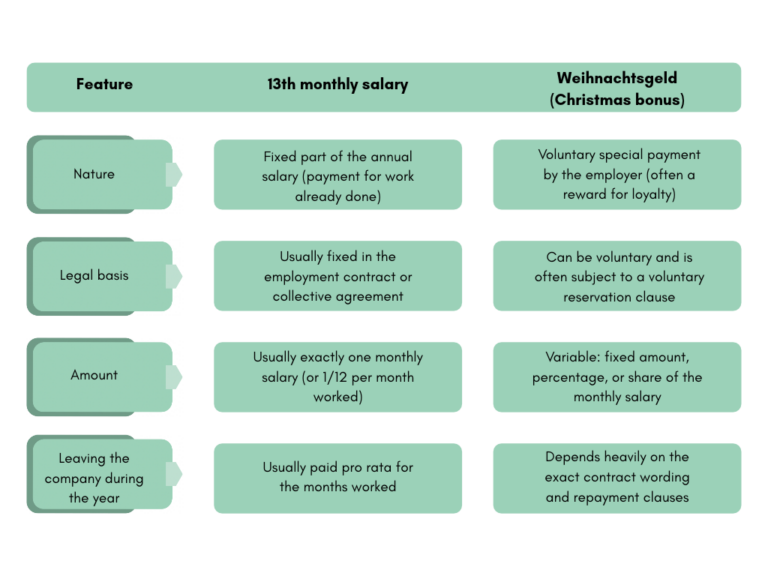
The core difference is the purpose of the payment. A 13th salary is pay for work you have already done, spread across the year. Weihnachtsgeld, on the other hand, often rewards loyalty to the company (Betriebstreue). Some bonuses serve both purposes, which German labor courts call a “mixed character” payment. In those cases, employees who leave during the year are usually entitled to a pro rata share.
How Much Christmas Bonus Is Normal?
There is no standard amount or percentage. The amount depends on the employer, the industry, and in many cases the collective agreement that applies.
Many employees receive one gross monthly salary in addition to their November pay, which is usually considered the upper end. Others receive a fixed amount, a percentage of their monthly salary, or a sum that increases with the number of years they have worked at the company. Industries with strong collective agreements, such as the metal and electrical industry, chemicals, or banking, tend to pay higher bonuses than sectors without them.
Part-Time Employees and Minijobbers
Part-time employees are entitled to a Christmas bonus in proportion to their working hours if their full-time colleagues receive one. Completely excluding part-time staff is not permitted under German law. The same principle of equal treatment applies more broadly. Employers may only exclude certain groups of employees from a bonus if they have an objective reason to do so.
Minijobbers and apprentices (Azubis) can also receive Weihnachtsgeld. Whether they do depends, again, on the contract or collective agreement.
How Is the Christmas Bonus Taxed?
For tax purposes, both Weihnachtsgeld and a 13th salary count as a sonstiger Bezug (other remuneration). They are fully subject to income tax and social security contributions, up to the respective contribution ceilings.
Because the bonus temporarily increases your income for that month, the tax deducted from your November payslip is calculated differently than for your regular salary. Many employees are surprised by how much of their bonus disappears in deductions. Still, you will always have more net income in total than without the bonus.
For international employees, there is one more point to consider. If you moved to Germany during the year, your annual tax situation may differ from that of colleagues who were here all year. Filing a tax return (Steuererklärung) can be worthwhile, because you may get part of the tax back.
Christmas Bonus and Minimum Wage
Employers are generally not allowed to use a once-a-year Christmas bonus to make up for a monthly salary below the statutory minimum wage. Your regular monthly pay must meet the minimum wage on its own. This is particularly relevant for employees in lower-paid roles, such as working students, minijobbers, or people in their first job in Germany.
Do You Have to Pay Back Weihnachtsgeld If You Quit?
This is one of the most common questions, especially among people who plan to change jobs in the new year. You only have to repay a Christmas bonus if your contract or collective agreement explicitly says so. Without a repayment clause (Rückzahlungsklausel), the money is yours.
If such a clause exists, German labor courts have set clear limits on how long it can bind you to the company. Small bonuses of up to 100 euros generally cannot be reclaimed at all. For bonuses between 100 euros and one monthly salary, an employer can usually require you to stay until 31 March of the following year. If you leave before then, you may have to pay the bonus back. For bonuses of one monthly salary or more, the binding period can extend until 30 June of the following year.
A 13th monthly salary is treated differently. Because it is payment for work already performed, you do not have to pay it back when you change jobs. Performance-related bonuses and commissions are also part of your pay and generally do not have to be returned.
Cut-Off Date Clauses
Some contracts contain a Stichtagsklausel (cut-off date clause). It states that you only receive the Christmas bonus if your employment relationship is not under notice on a certain date, for example on the payout date in November. Such clauses can be valid if the bonus rewards loyalty alone. If the bonus also pays for work performed during the year, courts have repeatedly found these clauses invalid, and employees can claim a pro rata share.
Can a Christmas Bonus Be Garnished?
If you have debts and a creditor has a garnishment order (Pfändung) against your salary, the Christmas bonus is partly protected. By law, Christmas payments are exempt from garnishment up to half of the monthly garnishment exemption amount. This threshold is adjusted every year on 1 July, and the protected portion of the Christmas bonus is currently just under 800 euros. Any amount above that can be garnished.
What to Check Before You Sign a Job Offer in Germany
For international professionals, the most important lesson is to read the salary section of your contract carefully. German job offers usually state an annual gross salary (Bruttojahresgehalt). Whether that salary is paid in 12 or 13 installments makes a big difference to your monthly budget, but not to your total annual income.
If a company advertises “€60,000 per year, paid in 13 installments”, your monthly salary is lower than with 12 installments, and one installment arrives in November. If the offer says “€60,000 plus Christmas bonus”, the bonus comes on top of your annual salary, which is a real increase in total pay.
When comparing offers, ask three questions. Is the bonus already included in the stated annual salary, or is it paid in addition? Is the bonus guaranteed by contract or collective agreement, or is it voluntary? And is there a repayment or cut-off date clause that could affect you if you change jobs within the next year?
Asking about this in a job interview or during contract negotiations is completely normal in Germany. Recruiters and HR departments expect candidates to understand the full compensation package, and clear questions show that you are making an informed decision.
A Welcome Extra, Not a Guarantee
The Christmas bonus in Germany is a common and welcome part of many compensation packages, but it is not a legal right. Whether you receive one, how much it is, and whether you might have to pay it back all depend on your contract, a collective agreement, or established company practice.
For international employees, the key is transparency from the start. Understand how your annual salary is structured, check for voluntary reservation and repayment clauses, and factor them into your plans, especially if you are thinking about changing jobs in the new year. If you have a concrete legal question about your contract, a labor law specialist (Fachanwalt für Arbeitsrecht) or your works council can give you reliable advice.
Follow CareerBee on Instagram for Our Christmas Specials🎄
The holiday season is here, and we have something for you. On our Instagram, you’ll find Christmas giveaways, quick career tips for international talent, and insights into working life in Germany. Follow us so you don’t miss a thing.
Check out CareerBee on Instagram